
Institut de la Méditerranée lends support to Coopmed
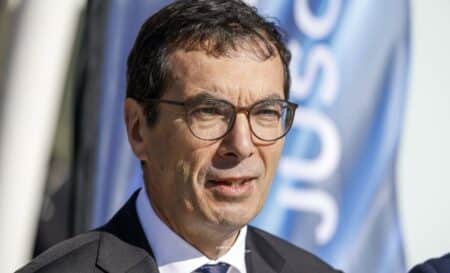
The Institut de la Méditerranée, chaired by Henry Roux-Alezais, will take on eligible projects through CoopMed (Photo: F. Dubessy)
MEDITERRANEAN. "With seventeen years’ expertise on Euro-Mediterranean issues, we are now going one step further by moving from expertise to structural action." Institut de la Méditerranée president Henry Roux-Alezais aims to "go further and faster, given the unprecedented economic crisis in the Mediterranean rim. What we have is a crisis of confidence, yet confidence is key to the economy." Thus, in order to resolve these problems, public projects and finance for private projects have to be optimised.
On this last point, the creation of CoopMed, a fund with a focus on the social economy, should be instrumental in getting projects set up. "In a number of studies, such as Elih-Med (see Elih-Med to make old houses more energy-efficient), we have had to seek out technical and technological innovations and new sources of finance. We target lenders who are interested not only in financial returns, but also in employment, the environment and sustainability", explains Henry Roux-Alezais. The new fund, which will be led by the Institut de la Méditerranée, will draw on the success of CoopEst, a body established by France, Italy, Belgium and Poland in Brussels in October 2005 to "initiate and foster the development of cooperatives, mutual societies, associations, foundations and social enterprises in central and Eastern Europe." The aim is to replicate the idea of CoopEst by adapting it to countries in the Mediterranean. However, CoopMed will go further than CoopEst, financing the SME sector. A €40M budget
Like CoopEst, CoopMed is based on a need: "Access to long-term capital from the private and public sectors", explains Henry Roux-Alezais, "is still limited and difficult for SMEs, mainly due to the fragility of their financial structures." CoopMed will bring together people from European countries in the Mediterranean rim and from the MENA region (Algeria, Egypt, Lebanon and Libya).
CoopMed has a budget of €40M, which will be disbursed in two equal instalments. This finance has been provided by major players such as the European Investment Bank (EIB), the World Bank and member banks of the European Federation of Ethical and Alternative Banks (Febea). While the structure established under Belgian law has a back office in Brussels, the Institut de la Méditerranée will provide front office services in Marseille from July 2011. "As an administrator and partner, we supply the pipeline by making it possible for agents to take up projects", says Henry Roux-Alezais. Thus, the Institut de la Méditerranée will seek out projects and professionals who can develop activities already in place in the country. Joint operations between countries north and south of the Mediterranean will also be permitted. Work on the first projects is expected to begin between now and the end of 2011. version française Frédéric Dubessy
Mardi 19 Juillet 2011
Lu 1187 fois
© Copyright Econostrum.info
Conformément au code sur la propriété intellectuelle, toute reproduction ou transmission de cet article est strictement interdite, sauf accord formel d'Econostrum.info |
Aux racines de la croissance verte en région Méditerranée
Par Dr. Christian Averous, économiste de l’Environnement Promouvoir une croissance verte dans la région Méditerranée, en soutien au développement durable et à la réduction de la pauvreté, s’impose comme défi majeur de notre temps. English version
Pour une réorganisation des relations entre l’Union européenne et les pays méditerranéens
Par Jean-François Coustillière, consultant sur les questions euro-méditerranéennes Aujourd’hui l’Union européenne (UE) dispose de trois cadres différents qu’elle a, elle-même, proposés, pour organiser la coopération en Méditerranée : le Processus de Barcelone (PB) né en 1995, la politique européenne de voisinage (PEV) née en 2003 et l’Union pour la Méditerranée (UpM) née en 2008.
Aspects géopolitiques de la crise syrienne
Par Michel Roche, consultant Depuis plus d’un an la Syrie vit un drame et on ne voit pas émerger une solution. Les résolutions pourtant peu ambitieuses des Nations Unies, ne sont pas respectées et l’envoi d’un contingent d’observateurs qui atteindra 300 hommes (sic) parait bien dérisoire face à l’ampleur de la crise.
|
|
||||||||||||||
|
|
||||||||||||||||


Par Dr. Christian Averous, économiste de l’Environnement
Par Jean-François Coustillière, consultant sur les questions euro-méditerranéennes
Par Michel Roche, consultant